Environmental Sustainability

Take responsibility for environmental protection as a corporate, continue to develop green products,
reduce the environmental impact and improve energy efficiency
and make the friendliest protection to the environment.

FSP works in line with the government’s Net zero 2050 plan and TWSE/TPEx Listed Company Sustainable Development Action Plan requirements with our mission to “provide the best value to customers, employees, and shareholders with innovative services and high-quality products” and our vision to “become the world’s leading provider of green energy solutions that penetrates people’s lives and contribute to the better environment”. We create the corporate value of sustainability and strive to fulfill our mission and responsibilities for our commitment to shareholders, environmental protection, customer trust, employee care, and social care.

FSP Group received a Bronze Medal in the 2024 EcoVadis Sustainability Rating. The 2025 assessment results are expected to be released by the end of February 2026.

1

Environmental management

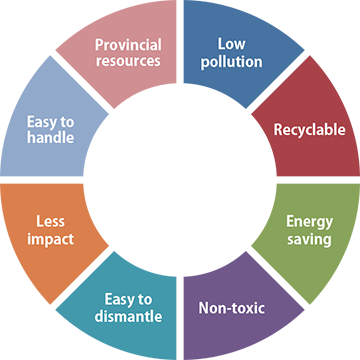
With more and more environmental impacts in recent years, the pursuit of green production is the goal pursued by each major industry. So does FSP Group. It is committed to the pursuit of clean production, the use of less resources and emission of less pollution, hoping to create more environment and product values. In order to reduce the impact of products on the environment in the manufacturing process and avoid more waste of resources and consumptions, green design is the main axis in product planning, towards low energy consumption and high efficiency. And use the resources that are easy to dismantle and recycle and reuse to reduce the impact on the environment.

In the environmental management, in addition to establish environmental management system ISO14001 and hazardous substances management QC080000 in each plant, FSP Group also spares no effort to promote other environmental protection and industrial safety activities, upholding the spirits and principles of P (Plan), D (Do), C (Check) and A (Action) of ISO system. In addition to follow relevant management system, FSP Group regularly diagnoses the company and plant’s energy-saving measures and come up with improvement measures based on the statistical analysis to reduce unnecessary energy consumption and sets environmental friendly targets in the environmental management objectives. In order to continue to achieve sustainable development goals and respond to the 2050 Net Zero Blueprint, FSP will invest a total of NT$30 million in green and sustainable deposits in 2024 to support green or sustainable projects.

I.Carbon reduction targets and target achievement status:

  1. Carbon reduction target:
    1. Aiming for a 30% reduction in Scope 1 and Scope 2 emissions by 2030, using 2021 as the baseline year.
    2. Regarding Scope 3, achieve a 20% reduction by 2030 and a 40% reduction by 2035, with 2024 as the baseline year.
    3. Achieving net zero emissions by 2050 and committing to RE100.
  2. Achievement status of carbon reduction goals:
    1. Total Scope 1 and Scope 2 greenhouse gas emissions in 2024 decreased by 8.32% compared to the 2021 baseline year. The 2025 inventory is currently in progress.
    2. As of the end of 2024, the renewable energy (RE) ratio reached 5.89%. The 2025 inventory is currently in progress.

II. Enhance the energy efficiency of products: in the analysis of the life cycle, we clearly understand that the main source of the largest carbon emission in the electronic product’s entire life is generated in the use stage, so in the development stage, in addition to compliance with the regulations, the annual goal of self-enhance of product energy shall move forward towards the set goals. At present, we have developed a new generation of adapter products in order to meet CoC V Tier2 specification, which is expected to reduce 40% of power consumption without loaded. We also continuously use MIA© IC, which can meet CEC 2018 10W/6W specification, significantly reducing the power consumption in standby mode. We do not limit to the satisfaction of efficiency regulation. Take desktop power supply for example. It is the first one to achieve 80Plus titanium gold the highest efficiency PC power supply.

2

Climate change : Carbon management and Energy saving equipment, and Renewable energy applications

Carbon management

Environmental degradation results in climate change. We, who keep using earth resources, shall more envisage the reduction of the energy and be committed to energy management. Based on that, in the energy management and greenhouse gas emission management, FSP Group makes use of ISO14064-1 greenhouse gas emissions management system, taking each plant of FSP Group as a category, to establish greenhouse gas emission inventory and inventory systematization in Taiwan headquarters and Kaohsiung branch and to establish documentation and regularly implement third-party verification operation.

The relevant examined and collected information will be disclosed official website and also participate client’s Carbon Disclosure Project, CDP. Each year it will publicize the data information of the examined greenhouse gas on this website on a regular basis.

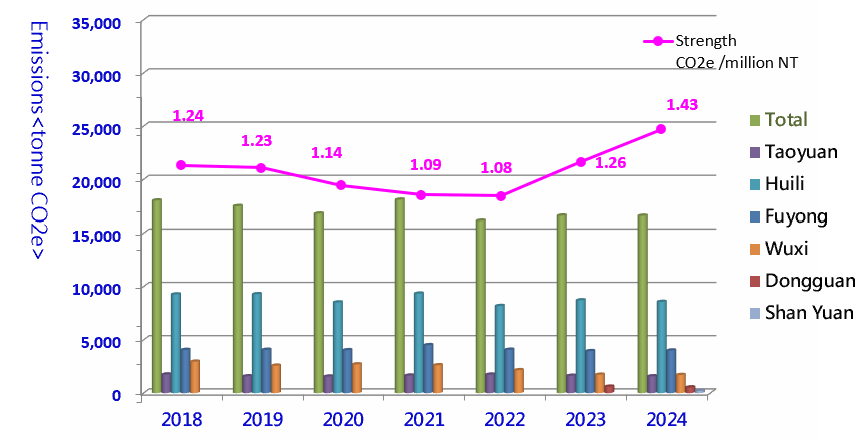
The table below presents the greenhouse gas emissions inventory results for 2024. The 2025 inventory is currently in progress:

  Taoyuan Huili Fuyong Fuyong Fuyong Shan Yuan Total And the proportion of total emissions
Scope1
Direct emissions
168.41 507.13 241.26 203.31 31.66 20.18 1,171.96 7.06%
Scope2
Indirect emissions
1,408.51 8,060.47 3,760.36 1,497.20 505.72 200.19 15,432.46 92.94%
Total 1,576.93 8,567.60 4,001.63 1,700.52 537.38 220.37 16,604.42 100.00%
Note1:
Direct greenhouse gas emission (emission in Category 1):
Including stationary equipment’s fuel combustion, process emission, mobile combustion source of transportation, fugitive sources (such as refrigerant escape and fire equipment, etc.). The total emission is 1,171.96 metric tons of CO₂e/year, accounting for 7.06% of total group emissions.
Note2:
Indirect greenhouse gas emission (emission in Category 2):
Main emission is from the purchased electricity and purchased steam. The indirect energy emission is 15,432.46 metric tons of CO₂e/year, accounting for 92.94% of total group emissions.

Figure: Greenhouse gas inventory emission in each plant over the years

Note1:The intensity is marked as 2024, counting forward year by year in order

Note2:Revenue of strength calculation is the group revenue

Energy Efficiency Improvement Measures

To enhance energy efficiency and reduce carbon emissions, FSP HuiLi Plant continuously promotes equipment upgrades and improvement projects. By introducing high-efficiency systems, we aim to reduce electricity consumption and lower greenhouse gas emissions, demonstrating our commitment to environmental sustainability. Below are the major energy-saving measures and their benefits in recent years :

Year Description of Energy-Saving Measure Investment (NTD) Annual Power Savings (kWh) Carbon Reduction (Metric Tons CO₂)
2025 At Zhi-Yi Department, PD3 and PD5 Workshops: Installed 2 new central air conditioning units 721,566 120,000 46.75
2024 At Zhi-Ba Section, 3rd Floor Workshop: Replaced 7 split-type air conditioners with a first-class energy-saving water-cooled central air conditioning system 650,000 15,000 5.84
2024 At C11 Building, 1st Floor: Replaced a 50P variable-frequency air compressor 311,121 144,000 56.10
Note:
In 2024, the electricity emission factor for the South China regional power grid was 0.3896 kgCO₂e/kWh.

Renewable energy applications

In order to increasing energy demand and growing environmental concerns , construction of solar panels at Wuxi Plant in 2020 , Taoyuan Headquarters and Plant 3 in 2023. Solar energy is characterized by sustainability. By adopting solar technology, FSP hopes to reduce energy costs, minimize carbon emissions, and play an environmental role at the same time.

Year 2023 2024 2025
China-Wuxi Plant The renewable energy generated is 1056,157 kWh, and CO₂ emission reduced by 813.56 tons. The renewable energy generated is 985,511 kWh, and CO₂ emission reduced by 759.14 tons. 1.Solar power generation reached 1,159,344 kWh, resulting in a reduction of 651.20 metric tons of CO₂ emissions.
2.Total expenditure for solar power system maintenance amounted to NTD 292,856.
Taiwan-Taoyuan Headquarters 1.The construction of solar panels for the Taoyuan headquarters and the third factory was completed and generated electricity.
2.Construction cost $ 10,780,125
3.The renewable energy generated is 166,405.4 kWh, and CO₂ emission reduced by 106 tons.
1.The construction of solar panels in the second factory is completed and generates electricity.
2.Construction cost $ 4,250,000
3.The renewable energy generated is 341,607.3 kWh, and CO₂ emission reduced by 168.8 tons.
Solar power generation reached 355,510.50 kWh, resulting in a reduction of 168.52 metric tons of CO₂ emissions.
Note
In 2024, the carbon emission factor for electricity in Taiwan was 0.474 kgCO₂e/kWh, while the electricity emission factor for the East China regional power grid was 0.5617 kgCO₂e/kWh.
3

Green design

When developing new products, FSP Group has immediately considered the potential environmental impact and evaluated the product’s life cycle, from raw material selection, processing, product packaging, transportation, consumers to disposal stage, etc. FSP Group is always upholding with sustainable business philosophy and promotion of green design concept. Adhering to customer’s quality as the goal and through strict control of environmental protection projects and part recognition units, RD has designed the green products that are in line with national environmental laws and regulations around the world. The company’s green design guidelines follow:

Design
1
  • Adopt route design with optimal performance to upgrade conversion efficiency
  • Consider mechanical parts to be light, easy to assemble and disassemble
  • Select components with lowest environmental noise
  • Reduce standby energy consumption
Production
2
  • Adopt low-pollution and low-energy process
  • Adopt high-efficient process
Package and
Transportation
3
  • Adopt recoverable or reusable package material
  • Select package material with lowest environmental noise
  • Adopt small-package volume, optimal load capacity and easy handling and transportation design
Application
4
  • Easy to install and operate
  • Easy to maintain and repair
  • With high reliability to extend useful life
  • Reduce energy consumption and carbon emission
Waste Recycling
5
  • Easy to disassemble and frequency separation at the end of its life
  • Cause no pollution of the environment when abandoning

The improvement of electricity conversion efficiency and reduction of no-load power consumption are always the goals for the company to develop high-efficiency power products. Take the products in 2012 as an example:

For PC power supply, among more than 4,600 models of 80 plus’s certified products, there are over 400 machines are qualified, which can help customer save about 10,000,000x300x10x300x 12%/1,000=1,080,000,000 KWH and reduce about 0.66 million tons of carbon emissions.

NUC power supply is a new generation of PC power supply, which can help customer save about 10,000,000x300x10x300x 12%/1,000=1,080,000,000 KWH and reduce about 0.66 million tons of carbon emissions.

TV power supply, evolved from CRT’s TV to LCD/LED TV, saving about 2,000,000x 150x 6 x300 x 15% /1,000=81,000,000 KWH and reducing about 50,000 tons of carbon emissions.

Adapter all series that in line with ErP level V products can save about 10,000,000x 60x10 x300 x 15% /1,000=270,000,000 KWH and reduce about 165,000 tons of carbon emissions.

SSL for lighting drive can save about 2,000,000x 60x 10 x300 x 85% /1,000=306,000,000 KWH and reduce about 0.18 million tons of carbon emissions.

It is roughly estimated that FSP Group’s power supply products on the market can save customers about 1.737 billion KWH or reduce about 1.055 million tons of carbon emissions, which is contributing to the environmental protection.

4

Environmental sustainability _ Conflict minerals

The exploitation of rare metals like cassiterite, black tungsten, coltan and gold in the Democratic Republic of the Congo and its surrounding countries has caused serious human right and environmental problems, which is known by the media as conflict minerals.

Although FSP Group has no the demand to directly purchase the minerals, based on corporate’s social responsibility and environmental protection practice, in order to avoid using illegal mining metals in raw materials and the production process, we express our concerns on the issue of conflict minerals to the suppliers and make a statement of no using conflict minerals to the suppliers. Through the conflict mineral reporting template between RMI and CMRT, we investigate relevant suppliers and require them to ensure that the use of raw materials will not lead to conflict minerals disputes.

Policy of FSP Group prohibits the use of conflict minerals:

Do not support and do not use the conflict mineral metals mined from armed conflict, illegal and poor environments in order to fulfill enterprise’s social responsibility. And ask suppliers to investigate whether their products contain gold (Au), tantalum (Ta), tin (Sn), tungsten (W), cobalt (Co) and other metals and to confirm the source of these minerals.

The company’s conflict minerals policy will be publicized in the website of FSP Group and will be advocated regularly at the supplier meeting.


hi this is over contact us
item is select